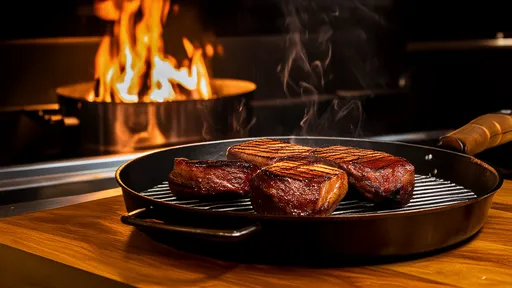
The sizzle of meat hitting a hot grill is more than just an auditory delight—it’s the sound of chemistry in action. At the heart of this transformation lies the Maillard reaction, a complex interplay of heat, amino acids, and reducing sugars that gives grilled meat its characteristic flavor, aroma, and color. When it comes to charcoal-grilled barbecue, the thermal radiation field generated by burning embers plays a pivotal role in optimizing this reaction. Unlike gas grills, which rely primarily on convection, charcoal fires emit intense infrared radiation that penetrates the meat’s surface, creating a unique efficiency in Maillard kinetics.
The Science of Charcoal’s Radiant Heat
Charcoal burns at temperatures exceeding 500°C (932°F), producing a robust thermal radiation field. This infrared energy doesn’t just cook the meat; it excites molecules at the surface, accelerating the Maillard reaction. The reaction, named after French chemist Louis-Camille Maillard, occurs when heat causes amino acids and sugars to rearrange into hundreds of new compounds. These compounds are responsible for the deep umami, roasted notes, and golden-brown crust that define premium barbecue. The radiant heat from charcoal is particularly effective because it delivers energy evenly, minimizing hot spots that can lead to uneven browning or charring.
Why Charcoal Outperforms Gas for Maillard Efficiency
Gas grills heat meat primarily through convection—hot air transferring energy to the surface. While effective for cooking, this method lacks the penetrating power of infrared radiation. Charcoal, on the other hand, emits a broad spectrum of infrared wavelengths, some of which are absorbed more efficiently by proteins and sugars. This absorption triggers the Maillard reaction at a faster rate, allowing for better crust formation without overcooking the interior. Additionally, the smoldering wood chunks or chips often added to charcoal fires release volatile organic compounds that further enhance flavor development, something gas flames simply can’t replicate.
The Role of Ember Positioning and Airflow
Mastering the Maillard reaction over charcoal isn’t just about heat intensity—it’s about control. The arrangement of embers and the management of airflow dictate the thermal radiation field’s consistency. A two-zone fire, where coals are piled on one side of the grill, allows for both direct radiant heat and indirect convection. This setup lets cooks sear meat over the embers to initiate the Maillard reaction, then move it to the cooler side to finish cooking gently. Adjusting vents to regulate oxygen flow ensures the coals burn cleanly and maintain steady radiation, preventing flare-ups that can scorch the meat and disrupt flavor development.
Cultural and Culinary Implications
Beyond the science, charcoal grilling carries cultural weight. From Korean gogigui to Argentine asado, the use of radiant heat from wood or charcoal is a tradition refined over centuries. These methods aren’t just about nostalgia; they’re rooted in the observable superiority of radiant heat for flavor. Modern chefs and food scientists are now quantifying what pitmasters have long known empirically: that the Maillard efficiency of charcoal is unmatched. As barbecue enthusiasts experiment with different woods, charcoal types (lump vs. briquettes), and grill designs, the pursuit of the perfect crust continues to evolve, blending ancient techniques with contemporary understanding.
Future Innovations in Thermal Radiation Cooking
While charcoal remains a gold standard, technology is catching up. Infrared grills, designed to mimic the radiant heat of charcoal, are gaining traction. However, purists argue that they still lack the nuanced flavor contributions of smoldering wood. Meanwhile, research into precise heat modulation—such as adjustable ceramic emitters or hybrid grill systems—aims to give cooks even greater control over Maillard kinetics. Yet, for now, the primal allure of charcoal, with its crackling embers and smoky perfume, remains the most effective way to harness thermal radiation for culinary perfection.
By /Jul 24, 2025
By /Jul 24, 2025
By /Jul 24, 2025
By /Jul 24, 2025
By /Jul 24, 2025

By /Jul 24, 2025
By /Jul 24, 2025

By /Jul 24, 2025
By /Jul 24, 2025
By /Jul 24, 2025
By /Jul 24, 2025

By /Jul 24, 2025

By /Jul 24, 2025
By /Jul 24, 2025
By /Jul 24, 2025
By /Jul 24, 2025
By /Jul 24, 2025

By /Jul 24, 2025
By /Jul 24, 2025

By /Jul 24, 2025
